

The Cheapest Price Is Not Always the Lowest Cost

This blog looks at why choosing a paper supplier on price alone may not always deliver the best overall value. Using paper as an example, we explore how product performance, delivery, returns and future pricing can turn a small initial saving into a higher long-term cost.
The blog covers:
- Introduction
- Does the Paper Suit Your Equipment?
- Can You Test It Before Ordering?
- How Will the Paper Be Delivered?
- Is the Quoted Price Sustainable?
- Will You Receive the Same Paper Next Time?
- Consider the Cost Behind the Price
- A Reliable Paper Supply from Polycopy
Introduction
Changing supplier because they have offered a lower paper price can appear to be a straightforward way to reduce costs. However, a quotation does not always show the full financial or operational impact of that decision.
Paper is a good example because prices can change considerably over time. Even a small saving across a large order may look attractive, but the benefit can quickly disappear if the paper performs poorly, deliveries create problems or the price increases after the first order.
Does the Paper Suit Your Equipment?
Two papers may have the same size, weight and brightness specification but behave very differently when used in a printer or copier.
Some lower-cost papers may create more dust, curl more easily or feed less consistently. This can lead to paper jams, misfeeds, poor print quality and additional wear inside the machine.
The cost is not limited to a few wasted sheets. Employees may need to stop what they are doing, clear the machine, reload the tray and print the document again.
Where a managed print agreement is in place, each printed page may also carry a click charge. A page that jams or prints incorrectly could still be charged, followed by another charge when the replacement is printed.
A small saving on the paper itself can therefore create additional costs elsewhere.
Can You Test It Before Ordering?
A paper that looks suitable on a specification sheet may not provide the finish, feel or performance you expected.
Before purchasing a large quantity, ask whether samples are available and test the paper in the machines that will use it most often.
It is also worth confirming what will happen if the paper proves unsuitable:
- Will the supplier arrange collection?
- Are return or restocking charges applied?
- How soon can an alternative product be supplied?
- Will the unwanted stock need to remain on site?
- Who is responsible if opened boxes cannot be returned?
Testing the product before ordering a pallet can prevent an expensive and inconvenient mistake.
How Will the Paper Be Delivered?
Delivery is another important part of the overall service.
A pallet of paper is heavy and needs to be moved carefully. The lowest quotation may only include delivery to the nearest accessible point, rather than to the print room, storage area or department where it is required.
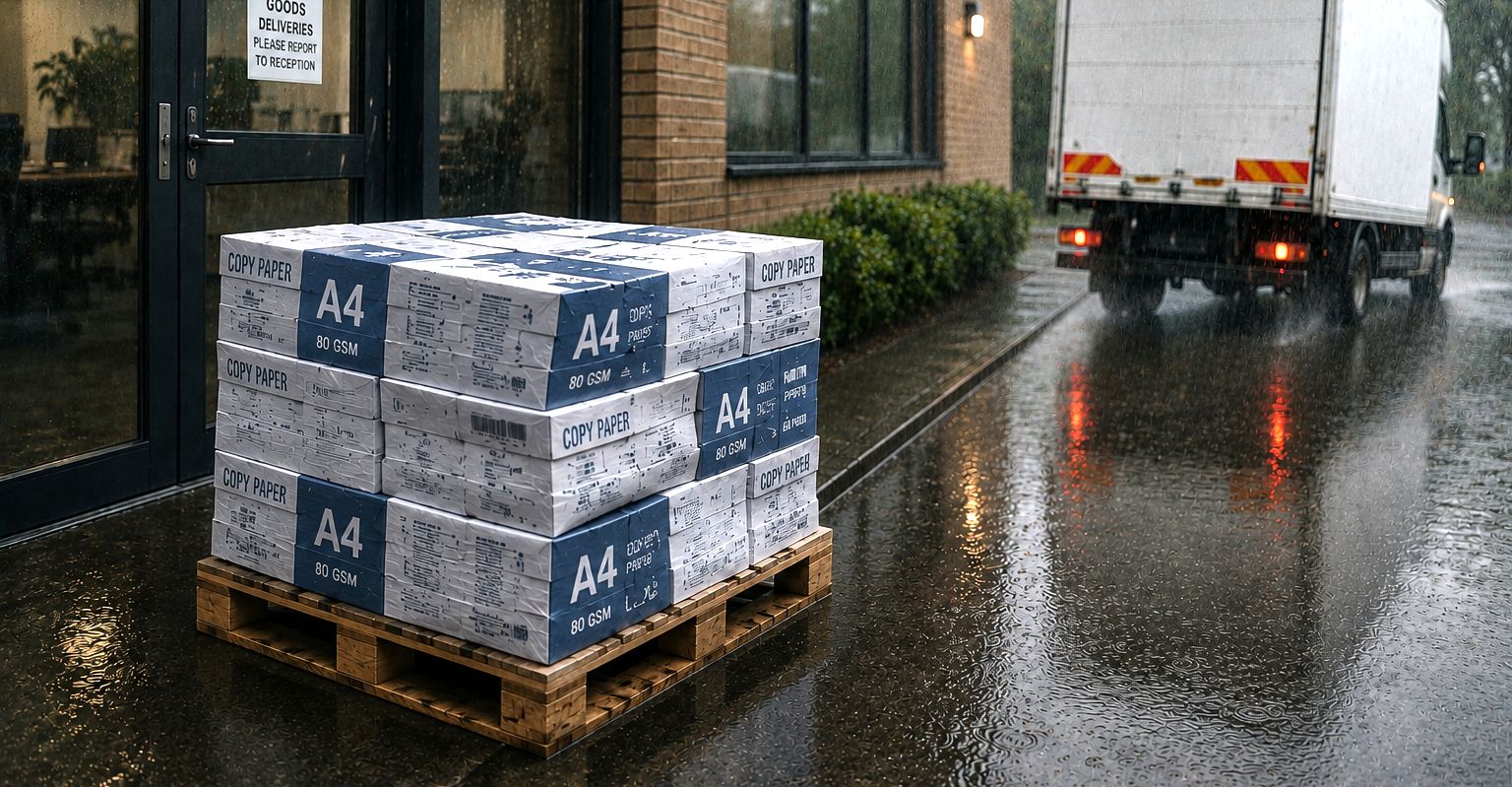
Before placing an order, check:
- Who will complete the delivery?
- Does the supplier use its own drivers or an external pallet network?
- Can the paper be positioned in the required area?
- What equipment will be used to unload and move the pallet?
- Who should be contacted if the delivery is delayed or damaged?
- Can urgent replacements be arranged?
A low delivery charge is of limited value if employees are left responsible for moving a heavy pallet through the building.
Is the Quoted Price Sustainable?
An unusually low price may be designed to secure an initial order rather than provide a dependable long-term rate.
Ask how long the quotation is valid and whether future orders will be supplied at a similar price. Delivery charges, minimum quantities and stock availability should also be considered.
Paper prices naturally move with the market, so no supplier can guarantee that prices will never change. However, there is a difference between genuine market movement and a heavily discounted first order followed by an immediate increase.
A consistent and transparent price can be more valuable than a temporary headline saving.
Will You Receive the Same Paper Next Time?
Product consistency is particularly important when you have found a paper that performs well in your equipment.
The branding and packaging may remain unchanged, but this does not always mean the paper inside is identical. Some suppliers may source paper from different mills while continuing to use the same wrapper.
Changes in the paper can affect thickness, stiffness, dust levels, colour and machine performance.
The packaging may look familiar, but the product may behave differently.
When comparing suppliers, ask whether they can provide continuity of supply and whether you will be told if the paper specification or source changes.
Consider the Cost Behind the Price
The price per ream is only one part of the overall cost.
A more accurate comparison should include:
- Paper quality and consistency
- Printer and copier reliability
- Wasted sheets and repeat printing
- Managed print click charges
- Delivery arrangements
- Returns and replacements
- Storage requirements
- Administration time
- Staff time spent dealing with problems
Lower-priced paper can provide good value when it performs reliably and is supported by an effective supplier.
The key question is not only:
“What is the price of the paper?”
It should also be:
“What will the complete supply, delivery and use of this paper cost us?”
A Reliable Paper Supply from Polycopy
Polycopy supplies paper in quantities ranging from individual boxes to regular pallet deliveries.
Our experienced drivers use tail-lift vehicles and motorised pallet trucks to handle large deliveries safely and efficiently. We take the time to understand individual site requirements so that orders can be positioned in the most suitable accessible location.
We also recognise the importance of consistency. When a particular paper has been tested and shown to perform reliably, we aim to continue supplying the same product rather than making unexpected substitutions.
Our pricing is based on building long-term customer relationships, not simply offering a heavily discounted first order that cannot be maintained.
Samples are available so that you can assess paper quality, appearance and machine performance before committing to a larger quantity.
To discuss all things paper, including grades, sizes, finishes, environmental options and pricing, contact the Polycopy team for advice on the most suitable products for your equipment, requirements and budget.
Published on 30 July 2026