

How Can the Right Classroom Furniture Support Alternative Provision?
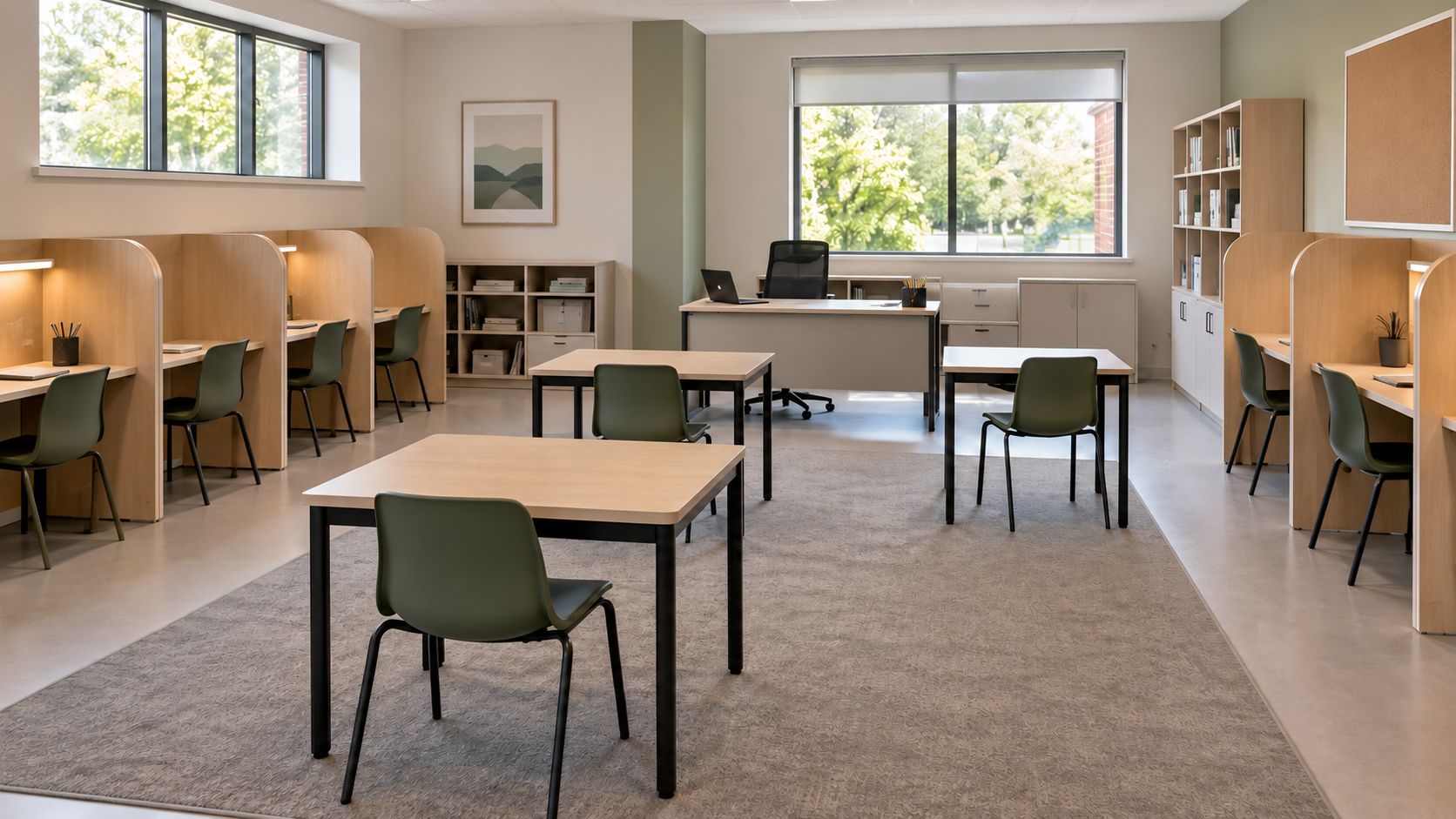
Creating an effective alternative provision classroom isn't necessarily about starting from scratch. For many schools, it's about making better use of an existing room and choosing furniture that helps pupils concentrate, feel comfortable and receive the support they need.
But what furniture works best in an alternative provision setting? And how should a classroom be arranged to balance individual learning, flexibility and staff supervision?
The answers depend on the pupils, the available space and how the room will be used.
With thoughtful planning, even a conventional classroom can be adapted into a more suitable alternative provision learning environment.
Understanding the guidance: The Department for Education published updated area guidance for SEND and alternative provision buildings in February 2026, covering the planning and design of new and refurbished settings.
What Should an Alternative Provision Classroom Include?
There isn't one standard furniture layout that suits every alternative provision classroom.
Some pupils benefit from individual workstations with fewer visual distractions, while others need space for supported learning, practical activities or occasional group work.
A suitable classroom layout should consider:
- Individual workspaces where pupils can concentrate
- Clear visibility across the room for teaching staff
- Flexible areas for one-to-one learning
- Durable, easy-to-maintain classroom furniture
- Sufficient space for movement around furniture
- The ability to rearrange the room as requirements change
The starting point should always be the pupils and staff who will use the space.
Schools can also refer to the government's statutory alternative provision guidance when considering their wider responsibilities.
Can Study Carrels Help Pupils Concentrate?
One furniture option worth considering for alternative provision classrooms is the study carrel.
A study carrel is an individual workstation with surrounding screens that create a more clearly defined working area.
Unlike a completely separate room, a study carrel allows a pupil to work within the main classroom while potentially reducing some of the visual distractions around them.
This can be useful where pupils need additional structure or find it difficult to concentrate in an open classroom layout.
Why consider study carrels?
- They provide a clearly defined individual workspace.
- Screens can help limit surrounding visual distractions.
- They can be positioned to maintain staff supervision.
- Starter and add-on units allow multiple workstations to be arranged together.
- They offer a way to create individual learning areas without permanent partitions.
For example, placing study carrels around the perimeter of a room can leave the centre available for individual tables, teaching activities and additional support.
However, screened workstations won't suit every pupil. Their positioning and suitability should be considered as part of the wider classroom design.
Choosing Furniture for Alternative Provision Classrooms
Furniture for alternative provision needs to do more than simply look suitable.
Classroom chairs, desks and workstations may be used intensively throughout the school day, making durability, stability and ease of cleaning important considerations.
Depending on the room, schools might choose a combination of study carrels, individual classroom tables and robust seating.
All-in-one classroom chairs with integrated writing tablets can also be useful where a compact individual workstation is required.
Rather than filling an entire classroom with one type of furniture, a mixed arrangement may offer greater flexibility.
The important question is whether the furniture supports the activities taking place in the room.
How Should an Alternative Provision Classroom Be Arranged?
The layout of the room can be just as important as the furniture itself.
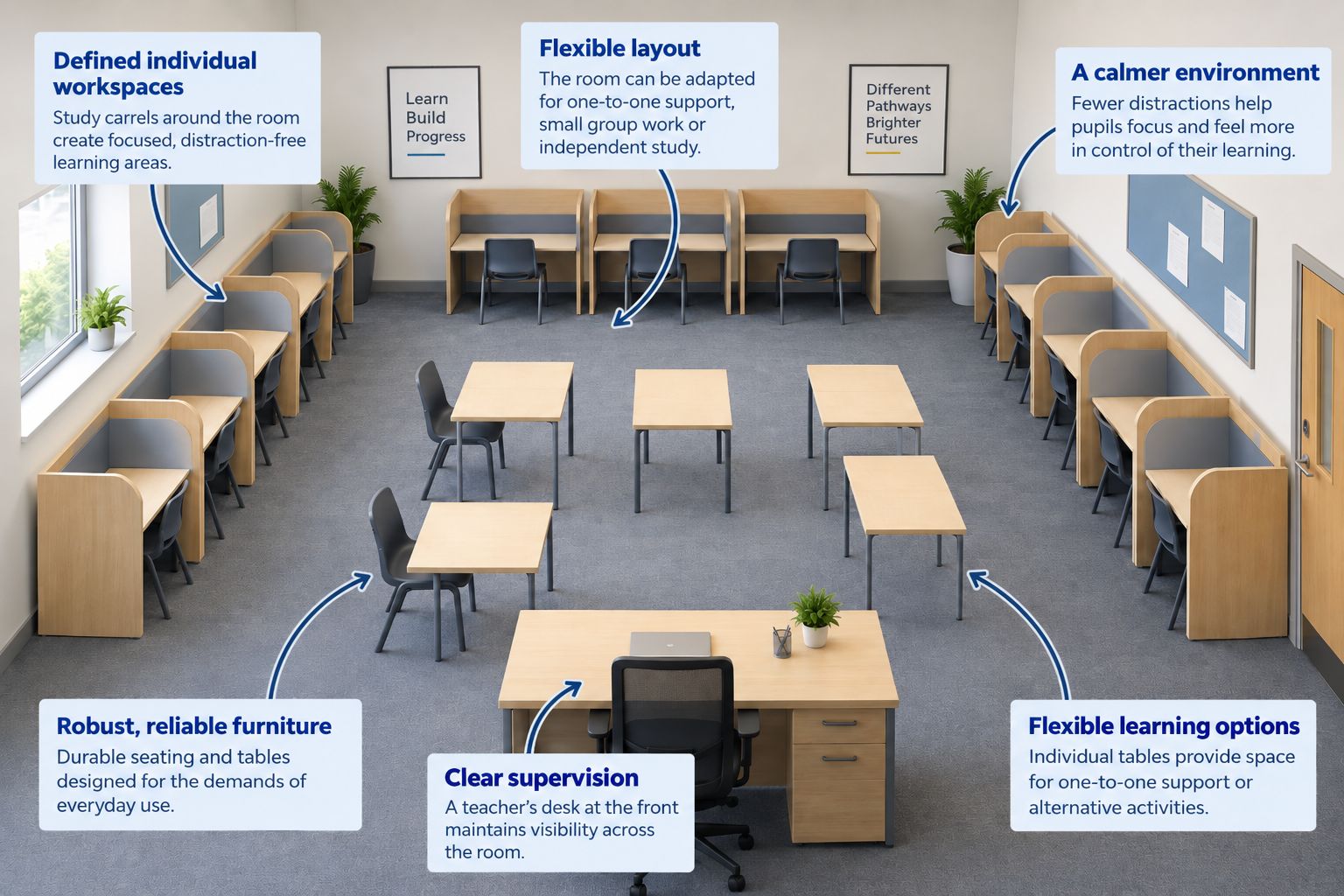
A traditional arrangement of shared classroom tables may be suitable for some activities, but schools creating alternative provision spaces may benefit from a more considered approach.
One possible arrangement could include study carrels along the walls, individual 600 x 600mm tables positioned centrally and a teacher workstation with a clear view across the classroom.
This can provide a combination of more focused workstations and open learning areas without major building alterations.
Before selecting furniture, consider:
- How many pupils will use the room at one time?
- Will individual work be the main activity?
- Where will staff provide one-to-one support?
- Can teachers see pupils clearly throughout the room?
- Is there sufficient space to move between workstations?
- Could the room need to accommodate different activities in the future?
Planning these details before ordering can help avoid choosing furniture that doesn't work well together.
Polycopy offers a complimentary CAD planning service to help schools visualise potential classroom layouts and assess furniture arrangements.
Explore Polycopy's education furniture and learning space fit-out service
Can You Convert an Existing Classroom into an Alternative Provision Space?
Yes. Depending on the requirements of the provision, adapting an existing classroom can be a practical alternative to creating an entirely new learning area.
Not every alternative provision setting requires specialist facilities, sometimes, introducing individual workstations, improving furniture arrangements or establishing quieter areas within a classroom can make the existing space more suitable.
In other circumstances, more extensive refurbishment or specialist facilities may be required.
The key is to understand what the room needs to achieve before deciding how much work is necessary.
This is also relevant to wider SEND and inclusive classroom design.
Read our related blog: Is Your School Ready for More Inclusive Learning Spaces?
Frequently Asked Questions
What furniture is suitable for an alternative provision classroom?
Study carrels, individual classroom tables, robust chairs and flexible workstations can all be suitable. The best combination depends on pupils' needs, available space and the activities taking place.
What is a study carrel used for in schools?
A study carrel creates a defined individual workspace with screens around part of the desk. It can help reduce visual distractions while allowing pupils to remain in a shared, supervised classroom.
Do alternative provision classrooms need specialist furniture?
Not always. Some rooms can use conventional classroom furniture arranged differently, while others may benefit from study carrels, specialist seating or other furniture suited to particular needs.
Can an existing classroom be used for alternative provision?
Yes. Existing classrooms can often be adapted through changes to furniture, layout and the way the space is organised. More specialised provision may require additional alterations.
Can Polycopy help plan an alternative provision classroom?
Yes. Polycopy can provide furniture advice, complimentary CAD room planning, furniture supply and installation, helping schools understand what could work within their available space.
Planning an Alternative Provision Classroom?
Choosing furniture is easier when you can see how everything will fit together.
Polycopy can help schools, colleges and academy trusts plan alternative provision learning spaces, from individual study carrels and robust classroom furniture to complete room layouts.
Whether you're adapting an existing classroom or considering a larger refurbishment project, we can help you explore suitable furniture and practical layout options.
Find out more about our education learning-space fit-out service
Published on 29 October 2026